
How Intelligence, Politics, and Foreign Interests Shaped America’s Religious Movements

Freddie Ponton
21st Century Wire
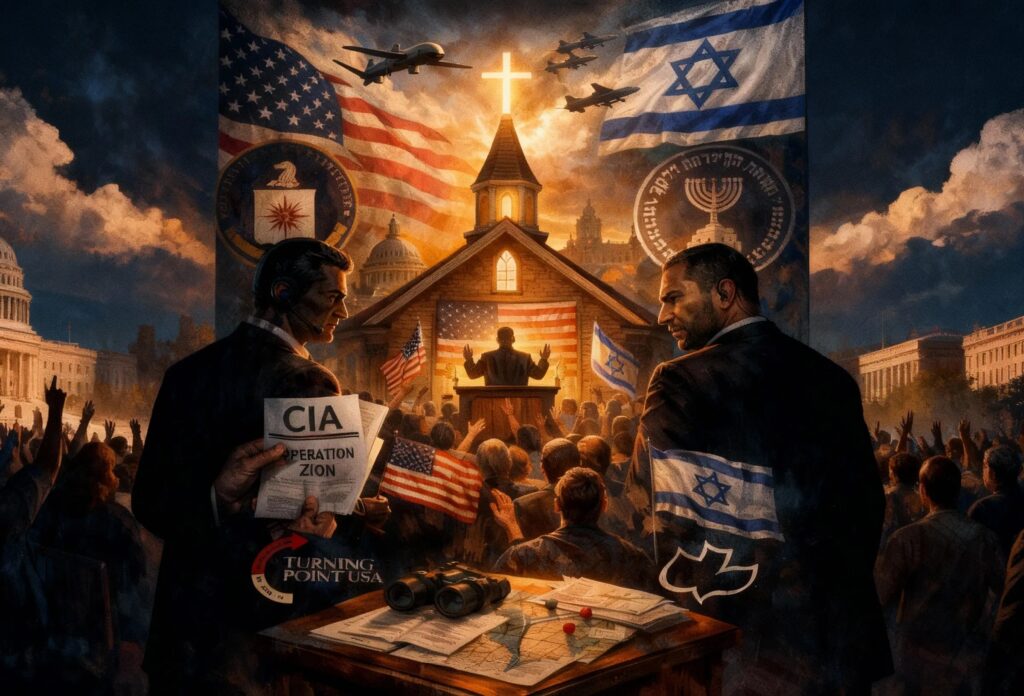
Christianity is back at the centre of American life, but not necessarily in the way most believers imagine. Churches are fuller, Christian language saturates politics, and faith-based identity has become a mobilising force once again. Yet beneath this revival lies a more unsettling reality: for decades, U.S. government agencies have treated religion not as sacred ground, but as strategic terrain.
This is not theory. During the Cold War, the U.S. State Department and intelligence agencies, most notably the CIA, recognised theology, doctrine, and religious institutions as instruments of influence. Faith was studied, guided, and at times quietly reshaped to serve geopolitical aims. The goal was rarely to destroy belief outright; rather, it was to domesticate it, align it, and render it strategically useful.
DOCUMENT: CIA’s use of journalists and clergy in intelligence operations – Select Committee On Intelligence Of The United States Senate One Hundred Fourth Congress, Second Session, July 17, 1996 (Source to download full pdf: US Senate Select Committee on Intelligence)
CIA Uses Journalists and Clergy 7 pages
Initiatives like the Doctrinal Warfare Program illustrate the scale of this engagement. Churches with mass followings, moral authority, and transnational reach were not simply tolerated; they were targeted for influence. Orthodox congregations in the U.S. and abroad were monitored to ensure alignment with Western interests. Catholic seminaries became conduits for doctrinal shaping, funding networks, and leadership development favourable to U.S. objectives. Even Protestant and Evangelical movements, decentralised and spontaneous, were quietly steered through cultural engagement, philanthropic networks, and selective amplification of certain voices.
The tragedy is that ordinary believers were never the enemy. They were, and remain, the collateral.
Sincere people seeking truth, purpose, and transcendence found themselves caught in influence systems they neither designed nor understood. Their worship, community, and faith became tools in a broader psychological and cultural battle they never consented to.
Doctrinal Warfare: When Theology Became a Battlefield
The CIA’s Doctrinal Warfare Program, particularly its work with Roman Catholic institutions, offers a rare glimpse into how intelligence agencies approach faith. Unlike cinematic portrayals of spies manipulating events, this program operated through subtler, more effective channels.
Influence was exerted via:
- Funding pipelines and philanthropic foundations, directing resources to seminaries, clergy travel, and publications
- Theological conferences and academic exchanges, creating opportunities to propagate ideas aligned with U.S. interests
- Publishing houses, journals, and media networks, shaping what doctrines and interpretations were elevated
- Selected intermediaries, often clergy or theologians, who could subtly shift discourse without appearing coerced
The program’s goal was not to dictate belief directly but to frame the boundaries of acceptable belief. Anti-communism, Western liberal ideals, and American exceptionalism were integrated into theological narratives. Over time, certain interpretations were elevated while others, particularly liberationist, socialist, or anti-Western emphases, were sidelined.
This structural influence was not limited to Catholics. Orthodox churches in the diaspora, particularly in Eastern Europe and North America, were monitored for political alignment. Protestant and Evangelical networks, decentralised and emotionally charged, presented different challenges. Leaders resisted hierarchical oversight, yet strategic use of media, donor support, and conferences quietly aligned these movements with larger political and global objectives.
The CIA and allied agencies like the Israeli MOSSAD also monitored global religious developments, from Latin America to Africa, mapping networks of clergy, seminaries, and youth movements. Influence became a form of psychological warfare: it did not coerce, but conditioned; it did not command, but subtly steered. And it thrived where people least expected manipulation, within trusted communities, sacred spaces, and moral authority.
SEE MORE: Honduras: The Making of a Controlled Democracy
VIDEO: David Wemhoff discusses his book John Courtney Murray, Time/Life, and the American Proposition: How the CIA’s Doctrinal Warfare Changed the Catholic Church. (Source: thkelly67 | Youtube)
.
Calvary Chapel, Charismatic Leaders, and the Power of Movements
Few movements illustrate both the promise and vulnerability of modern American Christianity like Calvary Chapel.
Founded in the mid‑1960s by Chuck Smith in Costa Mesa, California, Calvary Chapel emerged amidst the counterculture and the Jesus Movement. Smith welcomed surfers, hippies, and spiritual seekers alienated by both secular culture and institutional religion. Informal, emotionally open, culturally adaptive—and extraordinarily successful—it grew from a small congregation into a network of more than 1,800 churches worldwide.
Despite the ongoing debate about whether Calvary Chapel was created by individuals controlled by intelligence agencies or by charismatic individuals, the movement demonstrates a lesson intelligence agencies recognised decades ago: youth-driven religious networks are powerful instruments of social, political and cultural influence.
Figures like Lonnie Frisbee, a magnetic and unconventional evangelist, helped ignite the Jesus Movement and played a decisive role in Calvary Chapel’s early expansion. Frisbee’s countercultural persona, preaching on beaches, leading communal outreaches, and drawing thousands of young converts, was a force institutions could admire, attempt to understand, but never fully control.
Similarly, Paul Cain, a prophetic figure in charismatic networks, influenced theological subcultures with a focus on vision, revelation, and spiritual authority. According to reports, Cain was also a consultant to the Paranormal Division of the Central Intelligence Agency and the FBI. Like Frisbee, Cain became controversial, not because he was a confirmed intelligence operative, but because charismatic authority challenges hierarchical control, making it both influential and unsettling.
Calvary Chapel and these figures illustrate a key pattern: movements can grow organically, capture attention, and mobilise communities, making them valuable, and sometimes threatening, to political and intelligence structures. While the direct manipulation claims and the CIA militant connection remain debatable, historical examples like the Doctrinal Warfare Program prove that states do seek to shape religious institutions at scale, often through indirect methods rather than overt control, hence the lack of evidence thereof.
From Pews to Power: Evangelical Politics, Israel, TPUSA, and the Cost of Capture
By the late 20th century, Evangelical Christianity had evolved into a political powerhouse. Networks that began as spiritual awakenings now functioned as engines of political mobilisation, with youth-oriented, media-savvy outreach bridging the gap between churches and the political arena.
TPUSA and Charlie Kirk
Organisations like Turning Point USA (TPUSA) drew from these ecosystems, churches, conferences, campus ministries, and donor networks that had been shaped by decades of cultural, doctrinal, and ideological influence. Faith-language blended seamlessly with nationalism, free-market rhetoric, and civilizational anxiety, mobilising millions of voters.
The 2024 U.S. presidential election highlighted the real-world impact: Evangelical networks were decisive in returning Donald Trump to the White House. For believers, this was framed as a moral imperative or spiritual duty. For observers, it revealed how religious movements could be strategically leveraged within political frameworks.
The assassination of Charlie Kirk, co-founder of TPUSA, shocked the nation and intensified national reflection. While there is no direct evidence ( at least not yet), linking churches or religious movements to the attack, the public reaction underscores a critical truth: powerful social networks rooted in faith become conduits of influence, whether intended or incidental.
As unsettling as it may be for the US government, it is worth noting that an intense social-media rift has emerged between TPUSA and podcaster Candace Owens, with competing narratives and accusations fueling distrust of official accounts surrounding the Charlie Kirk killing at UVU. Interestingly, some critics, Candace Owens among them, contend that the assassination of Charlie Kirk carries the hallmarks of a sophisticated intelligence-style operation, raising uncomfortable questions about whether certain figures within TPUSA may have been more deeply entangled in the events than the public has been led to believe. A decentralised, global network of self-styled citizen journalists is currently crowdsourcing footage, timelines, and open-source data, arguing that gaps and inconsistencies warrant deeper scrutiny beyond mainstream reporting. This phenomenon has amplified public pressure on agencies such as the FBI and on TPUSA to clarify unanswered questions and reconcile discrepancies in their account of the events of September 10, 2022.
Much like the unresolved shadows that followed the JFK assassination, Charlie Kirk’s killing has placed intelligence agencies, the military, the FBI, and even foreign actore like Israel at the center of a fraught public controversy, not through proven culpability (at least not yet), but through the swirl of suspicion and unanswered questions that inevitably surround the death of a defining religious and political figure in the American conservative sphere, leaving many to ask whether this is coincidence or something more troubling left unexplained.
Christian Zionism and Israeli Influence
No discussion of modern Evangelical power is complete without considering the strategic relationship between U.S. Evangelicals and the State of Israel.
This alliance is public and well-documented. Evangelical Christians, especially in the United States, became one of the most reliable pro-Israel voting blocs, influenced not just by policy arguments but by theological frameworks, Christian Zionism, which frames Israel as divinely central to biblical prophecy.
Israeli political leaders and advocacy organisations have cultivated this alignment via:
- Pastors’ conferences in Israel
- Evangelical media networks and tours
- Donor networks and lobbying partnerships
Organisations such as Christians United for Israel (CUFI) mobilise millions of voters, influence Congressional votes, and amplify foreign policy priorities. During the Trump administration, these networks helped drive decisions like the Jerusalem embassy relocation, Iran policy shifts, and strengthened U.S.-Israel alignment.
Yet this partnership is not uncontested. Younger conservatives and Evangelicals, particularly those aligned with independent thinkers like Charlie Kirk, increasingly question whether faith-based loyalty to foreign policy interests undermines America-first priorities. This generational tension highlights a growing divergence within conservative Christianity: between inherited religious-political alliances and emerging calls for national sovereignty, prudence, and domestic priority.
Moreover, the case of Turning Point USA illustrates how foreign influence can intersect with faith-based movements to shape political power. TPUSA’s open alignment with pro-Israel advocacy networks, from educational trips and conferences to donor engagement, demonstrates how theological and ideological commitments can be leveraged to advance strategic interests. This organisational alignment and associated messaging reveal a clear pattern of external actors using popular religious and political networks to sway domestic policy and voter priorities in the United States. This dynamic mirrors broader trends seen in movements like Calvary Chapel, where charismatic leaders and faith communities, intentionally or not, become conduits for shaping societal and political behaviour, highlighting how belief can be instrumentalised as a tool of influence. Believers are constantly reminded by pastors such as Garid Beeler, of VISION Calvary Chapel in Irvine, CA, that they need to unconditionally embrace the so-called God’s plan for Israel, which in their eyes legitimises Israel’s occupation of Palestine, and the subsequent genocide, on the basis that the Lord specifically gave the Hebrews the land thousands of years ago.
Believers as Collateral in the Machinery of Influence
The story of institutional capture is not about disloyal Christians or malign churches. It is about power exploiting vulnerability.
The State Department, CIA, and allied actors ike Israel did not invent faith crises, but they mastered the art of steering movements. They understood that belief motivates action, doctrine shapes identity, and institutions built on trust are uniquely vulnerable to manipulation.
Jay Dyer’s analysis, which we are featuring today, frames this landscape without demonising believers: faith itself is not the enemy, but it has been treated as a resource, managed, redirected, and at times hollowed out by forces whose goals are strategic, political and financial, rather than spiritual.
If Christianity is to withstand this era with integrity intact, it will require discernment, humility, vigilance, and, of course, the ability to separate the Gospel from the machinery of power. The war was never against believers, but belief, as an institution, has been under attack all the same.
Jay Dyer writes about the historical and geopolitical factors of state and private interference in ecclesial and religious affairs…
Institutional Capture Explained: The State Dept, CIA & Orthodox, Roman Catholic & Protestant Churches
The notion of state interference in the life of the Church is well known to students of Church history: Arian Emperors, Imperial support for iconoclasm, the Frankish and Germanic control of the papacy, as well as the investiture controversy should all come to mind. These famous scandals demonstrate the persistent cunning on the part of the state to install, influence and control religiosity in the realm, and to students of geopolitics this should also come as no surprise. What is odd, however, is that when this concept arises in modern discussions, it is relegated immediately to the domain of “conspiracy theory,” unless of course you are talking about the KGB and NKVD relationship to Russian clerics in the 20th century.
It only turns out to be a “conspiracy theory” when one points to the US State Department, the CIA, various foundations, NGOS and academic institutions (often closely linked to the intelligence apparatus) – all of whom openly seek to alter and change Orthodox theology, as well as the theological positions of the Roman Catholic and Protestant communions. First, it is worth noting that missionary work is a classic espionage cover: Obviously, I don’t mean all missionaries are spies, but that it has famously been a useful cover for espionage work, which is precisely why Russia has recently banned groups like the Jehovah’s Witnesses and Scientology. These entities can be used as a form of soft power or even more covert intelligence operations. Similarly, classic cover for foreign operations of this sort has used aid organisation cover, such as the Red Cross or USAID.
In fact, even mainline publications regularly report this fact, though it seems to be lost on so many, especially among the intelligentsia who pride themselves on grasping the practicality of realpolitik. Christianity Today writes:
“Many of America’s first spies were missionaries or came from missionary backgrounds. Often enough, they were the only Americans who had lived abroad—not just among locals but as locals. While other American spies learned about the world through books and couldn’t really grasp its full range of quirks and complexities—“like tourists who put ketchup on their tacos,” as Sutton puts it—missionaries spoke several languages and knew the subtle differences between local dialects. They understood local cultures and faiths from the ground up and knew intuitively how to navigate between them. They knew, in short, “how to totally immerse themselves in alien societies.” But they always identified first and foremost as Christians and as Americans, and when they were called to serve the nation, they did not hesitate to do so.”
This was not unique or new; Orthodox monastic spies were also used by British intelligence in the infamous case of “Father Dimitrios”:
“The story of Father Dimitrios, or David Balfour, who turned out to be a British spy in pre-World War II Greece, is a fascinating yet relatively little-known chapter in modern Greek history.
Father Dimitrios, the monk with the voice of an angel, turned out to be a spy for the British Intelligence Service. That’s a shame because the mission and wartime actions of the British priest could make a nail-biting spy novel or film.
From 1937 to 1939, the English spy, wearing his priest’s robes and his long, bifurcated beard, performed his ecclesiastical duties close to Greece’s royal family. His relations with King George II, the successor to King Paul and Princess Frederica, were especially close. His access to the royal palace undoubtedly gave him access to valuable information.
British Intelligence must have learned a great deal about the Greek royal family during these crucial prewar years. King George II was a paternal first cousin of Queen Elizabeth’s husband, Prince Philip, the Duke of Edinburgh.
Members of the royal family often confessed to their beloved priest. At the same time, Balfour, under the cover of Father Demetrios, forged important acquaintances with high-ranking military officers and politicians with the blessings of the palace.
During World War 2, for example, dozens of missionaries were using their clerical cloaks as their espionage cloak, spying for the Allies. Time Magazine explains:
“His [Protestant Missionary Alfred Eddy] most audacious undertaking included a plot to “kill,” as he described it, “all members of the German and Italian Armistice Commission in Morocco and in Algeria the moment the landing takes place.” In a straightforward and matter-of-fact memo, he told OSS head William Donovan that he was targeting dozens of people. He additionally ordered the executions of “all known agents of German and Italian nationality.” Never one to mince words, he called the proposal an “assassination program.”
To orchestrate his bloodthirsty plot, Eddy hired a team of Frenchmen. He planned to frame the executions as a “French revolt against Axis domination.” “In other words,” he explained to Donovan, “it should appear that the dead Germans and Italians were ‘the victims’ of a French ‘reprisal against the shooting of hostages by the Germans and other acts of German terror,” and not an OSS operation.
At about the same time that he was recruiting French hitmen, he wrote to his family about the sacrifices he was making for Lent. He described the Easter season as “abnormal” this year. “I am certainly abstaining from wickedness of the flesh,” he confessed. With his wife thousands of miles away, that was not too difficult. “I haven’t even been to a movie since Lisbon, I don’t overeat anymore, and I allow myself a cocktail at night, but never before work is all done.”
And,
“American intelligence leaders had stumbled upon the fact that missionaries make great spies. They have excellent language skills, they know how to disappear into foreign cultures, and they are masters at effecting change abroad. But while missionary spooks believed that their wartime work was necessary, they also wrestled with the moral ambiguities inherent in their actions.”
This is just one example among countless, but it serves to illustrate the point – in this case, the supposed man of the cloth is engaged in assassination missions. A fortiori, the US Government would also see the power in utilising religion for the promotion of Americanism. During the Cold War this was ramped up to extreme degrees as CIA operatives and strategists like C.D. Jackson allied with media magnate and Skull & Bonesman Henry Luce – of Time Magazine, to recruit various prominent academics and Jesuits like John Courtenay Murray to help ensure the Vatican and in particular the Second Vatican Council, would include in its dogmatic degrees new doctrinal statements that were amenable to Americanism. This unique style of interference was even highlighted by a congressional investigation in 1996 into the CIA’s use of ministers and journalists here (including Peace Corps Volunteers).
This was combined with separate operations from Helliwell, Angleton, Donovan & Colby to utilise Opus Dei, the Vatican Bank and drug running for black operations funding in the now infamous Operation Gladio, which also saw the See of Rome aligning itself with organised crime to supposedly “save the world from communism.” However, as Catholic lawyer David Wemhoff has demonstrated in his masterful and unparalleled 800-page, vastly sourced tome, John Courtney Murray, Time/Life Magazine and the American Proposition, Jackson’s now declassified “Doctrinal Warfare Program” led the Roman Church into the hands of new masters at the US State Department and the CIA.
Indeed, this is precisely why Pre and Post-Vatican 2 popes, from Pius XII to Paul VI to John Paul 2 were meeting with Colby, Kissinger and William Casey on a consistent basis during the Cold War. And, if you are a perceptive reader, you can already piece together the blackmail and compromise operations that the world has seen through the Epstein saga were simply a window into how these institutions were similarly blackmailed and compromised, which is why there have been so many scandals in the Roman Church concerning pedo crimes, and likely relates to why Benedict resigned.
In regard to the Protestant Churches, the Rockefeller family is quite proud of, and openly brags about their influence and dominance of the Protestant religious world, through their donations and tax-free foundation offerings. These offerings, of course, come with strings attached, such as the decision to push the newly formed “social gospel” concept of the early 20th century. Eventually, the Rockefellers were creating entire seminaries and universities dedicated to the promotion of David’s influences from Keynesian/Fabian and Austrian economic theory, as well as Malthusianism and eventually technocracy, through the recruitment of Zbigniew Brzezinski after the publication of his seminal 1970 text, Between Two Ages: America’s Role in the Technetronic Era.
Few know David Rockefeller himself spent time in intelligence work and transferred this knowledge of networking and banking operations into his business ventures, as he discusses in his Memoirs. In fact, Brzezinski’s book also includes chapters discussing the role of the Post-Vatican 2 Roman Catholic Church in the promotion of Americanism and technocratic hegemony. It should also be noted that the Rockefellers didn’t merely have an interest in steering the Protestant and evangelical churches into liberalism and modernism, but also set their sights on Rome and Orthodoxy, as Wemhoff notes.
For the Orthodox World, the price of siding between two thieves came at a high cost, as the Orthodox England blog notes, concerning the place of the Russian Orthodox Church between the KGB and the CIA. Similarly, it has recently been declassified that the OSS placed pressure on the Patriarch of Constantinople, as the CIA said:
“In an OSS interoffice memo dated March 26, 1942, an intelligence agent named Ulius L. Amoss wrote this to a fellow OSS agent named David Burns:
The Archbishop was extremely pleased at having met and lunched with you. He has told me that the entire facilities of his organisation are at our disposal. He put it in these words:
“I have three Bishops, three hundred priests and a large and far-flung organisation. Everyone under my order is under yours. You may command them for any service you require. There will be no questions asked, and your directions will be executed faithfully. Please tell Mr Burns for me that this is so.”
A month later, on April 25, the 56-year-old Greek Archbishop attempted to enlist in the U.S. Army. He was turned down.
A few weeks after that, on May 14, Ulias Amoss, the same intelligence agent who wrote the March 26 memorandum, wrote a letter to Athenagoras, thanking him for the Greek Archdiocese’s ongoing cooperation, saying, in part, “The care with which your Bishops and Priests have cooperated has impressed everyone and the report that, perhaps, as many as a hundred thousand names will be returned to us is astounding.” On the same day, William J. Donovan himself — the head of the OSS — also wrote to Athenagoras, “The reports and descriptions of Greek-American youth of military age so kindly undertaken by you are coming in in splendid volume. The care with which Your Grace has managed this important service is of great interest to our armed services, and I wish to express my deep appreciation for your loyal and patriotic assistance.”
This special relationship with US intelligence never ended and continues to this day as the backdrop to the actions of the Phanar and GOARCH in the US:
“Archbishop Elpidophoros, the head of the Patriarchate of Constantinople’s Greek Orthodox Archdiocese of America, was the honoured guest at the National Intelligence University in Maryland earlier this week, where he delivered an address to the U.S. intelligence community.
The university brings together faculty and students from all 18 of the nation’s intelligence communities.
As the Greek Archdiocese notes, the Archbishop’s talk on “Russia’s Weaponisation of Religion in the Ukraine Conflict” was the first-ever address from a GOARCH leader to the U.S. intelligence community. At the same time, the Patriarchate of Constantinople has a long history of cooperation with the U.S. intelligence community, as detailed in documents released by the CIA.”
While it may seem like a far-off footnote in a dusty history book on Byzantium or the Borgia Papacy, the reality of state and private interference (and control!) in religion is a stark reality. The goal of the state is the maintenance and projection of power, simply put. Religion is a tremendous force for control and power in the world, both good and evil, but for the state, religion is simply another domain of human culture for the projection of power, and in today’s world, that is most often projected as soft power.
If you have not read Joseph Nye’s famous essay on Soft Power, I recommend it here. Understanding soft power gives a window into the attitude of the power elite and their perspective on religions and sects as tools – pawns on the grand chessboard, to use Brzezinski’s terminology. One need only think of Brzezinski’s own recruitment and usage of what would become Al Qaeda in the Soviet War in Afghanistan in Operation Cyclone – the usage of a radical religious sect for US objectives – as a classic example.
21st Century Wire is an alternative news agency designed to enlighten, inform and educate readers about world events which are not always covered in the mainstream media.
Source: https://21stcenturywire.com/2025/12/30/__trashed-2/
Anyone can join.
Anyone can contribute.
Anyone can become informed about their world.
"United We Stand" Click Here To Create Your Personal Citizen Journalist Account Today, Be Sure To Invite Your Friends.
Before It’s News® is a community of individuals who report on what’s going on around them, from all around the world. Anyone can join. Anyone can contribute. Anyone can become informed about their world. "United We Stand" Click Here To Create Your Personal Citizen Journalist Account Today, Be Sure To Invite Your Friends.
LION'S MANE PRODUCT
Try Our Lion’s Mane WHOLE MIND Nootropic Blend 60 Capsules
Mushrooms are having a moment. One fabulous fungus in particular, lion’s mane, may help improve memory, depression and anxiety symptoms. They are also an excellent source of nutrients that show promise as a therapy for dementia, and other neurodegenerative diseases. If you’re living with anxiety or depression, you may be curious about all the therapy options out there — including the natural ones.Our Lion’s Mane WHOLE MIND Nootropic Blend has been formulated to utilize the potency of Lion’s mane but also include the benefits of four other Highly Beneficial Mushrooms. Synergistically, they work together to Build your health through improving cognitive function and immunity regardless of your age. Our Nootropic not only improves your Cognitive Function and Activates your Immune System, but it benefits growth of Essential Gut Flora, further enhancing your Vitality.

Our Formula includes: Lion’s Mane Mushrooms which Increase Brain Power through nerve growth, lessen anxiety, reduce depression, and improve concentration. Its an excellent adaptogen, promotes sleep and improves immunity. Shiitake Mushrooms which Fight cancer cells and infectious disease, boost the immune system, promotes brain function, and serves as a source of B vitamins. Maitake Mushrooms which regulate blood sugar levels of diabetics, reduce hypertension and boosts the immune system. Reishi Mushrooms which Fight inflammation, liver disease, fatigue, tumor growth and cancer. They Improve skin disorders and soothes digestive problems, stomach ulcers and leaky gut syndrome. Chaga Mushrooms which have anti-aging effects, boost immune function, improve stamina and athletic performance, even act as a natural aphrodisiac, fighting diabetes and improving liver function. Try Our Lion’s Mane WHOLE MIND Nootropic Blend 60 Capsules Today. Be 100% Satisfied or Receive a Full Money Back Guarantee. Order Yours Today by Following This Link.


| Visits: | 1,763,634,001 |
| Stories: | 8,557,992 |
Whistler Blowers, Insiders

