

Unpardonable offenses: US government policy vs. Cuba


by JR Valrey, The People’s Minister of Information
Ninety miles from the shores of Florida, the US government imposed a policy of economic strangulation via a Blockade on the economy of the Caribbean nation of Cuba nearly seven decades ago, all because the Cubans want to practice sovereignty – to maintain the right of Cubans to determine what happens in Cuba.
In January of ’26, the US government imposed a complete oil Blockade on Cuba, after abducting Venezuelan President Nicoloas Maduro, a close ally of Cuba, completing depriving the island’s 11 million people of oil and greatly hindering social life, where food distribution, transportation, the pumping of water and general electricity among other aspects of life, depend on oil.
With the resilience of the Cuban people being displayed at this critical time, doing what they can to fight off the US goverment imposed “slow genocide,” Russia has also recently broken through the US military’s oil blockade of the island to deliver a much needed shipment of oil, and thousands of people recently descended on the island from around the world with the Nuestra America Convoy, to show person to person solidarity with the Cuban Revolution. An enormous amount of solidarity is also coming from the Black Liberation struggle in the US and the Pan African struggle in the greater world.
As the call for the end of the Cuban Blockade grows louder and louder within the United States and throughout the world, I wanted to talk with Second Secretary of the Cuban Embassy in the US Gabriella Castillo about what is happening on the island and within international geo-politics during this crucial time.
JR Valrey: How has the US government’s inhumane and criminal oil Blockade, since the beginning of the year, affected the Cuban people and different sectors of society on the island?
Second Secretary Gabriella Castillo: First of all, thank you very much for providing this space. To discuss the current situation in Cuba, it is vital to understand that we are not looking at an isolated phenomenon. While the Executive Order of Jan. 29, 2026, has escalated the crisis to unprecedented levels, this is a history of energy siege that intensified in 2019 and is entirely tied to the policy of the US Blockade that Cuba has faced for nearly 70 years. What we see today is also the cumulative impact of years of persecution against every ship and every fuel transaction attempting to reach the island.
Today, the absence of oil is not just a statistical problem; it impacts the life of a nation. With an unstable power grid and blackouts that can sometimes exceed 20 hours a day, every aspect of daily life — from water pumping to education — is impacted. But where this Blockade becomes especially cruel is in the healthcare sector, a field that the Cuban Revolution has defended and maintained for years as a fundamental human right.
The healthcare system faces challenges that defy humanitarian logic. Currently, we have a surgical waiting list of over 96,000 patients. The most painful part of these figures is the human face behind them:
- Over 11,000 children and nearly 5,000 cancer patients are waiting for surgeries that are being postponed due to a lack of supplies or stable energy.
- Vital services such as hemodialysis (on which nearly 3,000 people depend) and radiotherapy (for 16,000 patients) are at constant risk due to electrical instability.
- The Maternal and Child Health Program is suffering directly: 32,000 pregnant women are struggling to access diagnostic ultrasounds, and more than 30,000 children face delays in their vaccinations because the cold chain for the doses cannot be guaranteed.
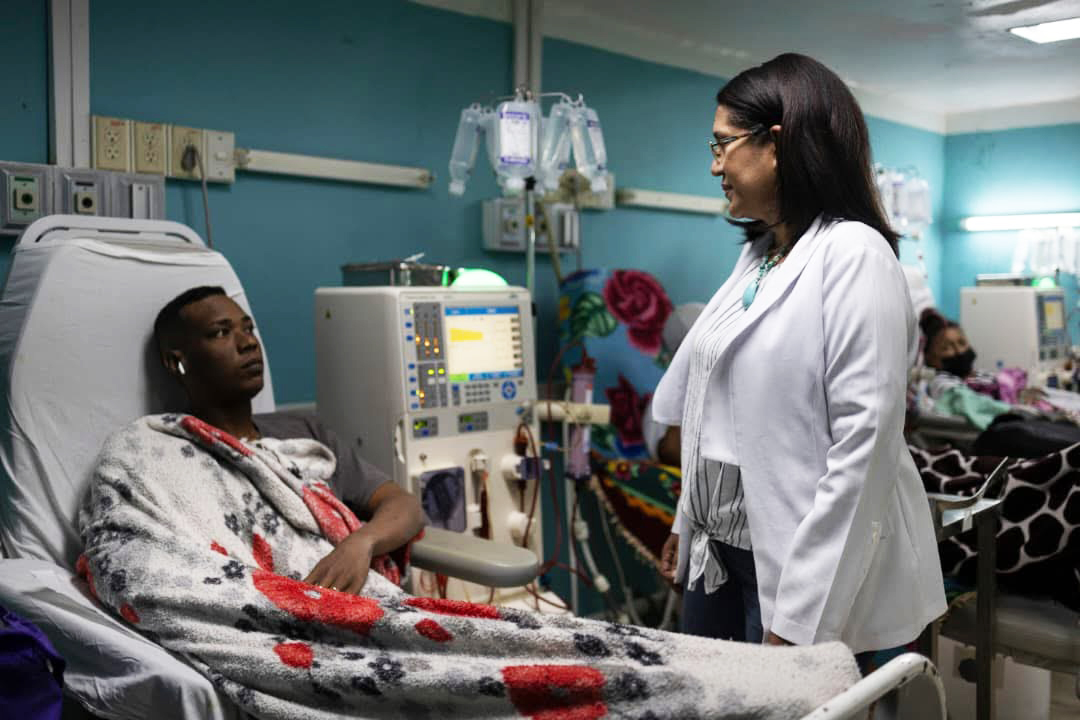
However, it is fundamental to highlight that if our healthcare system has not collapsed, it is thanks to the titanic effort of our doctors and scientists, and a national contingency strategy. Cuba has not stood idly by:
- We are accelerating a sovereign energy transition. We have already installed solar panels in 282 polyclinics, 15 hospitals, and dozens of maternal and nursing homes. Power supply for hospital centers is strategically prioritized over any other economic sector.
To summarize, what we are facing is a siege designed to suffocate the survival logistics of a people. Despite limited resources, the state’s priority remains saving lives, but the human cost of this policy of energy persecution is, quite simply, incalculable.
JR Valrey: With the Russian oil tanker reaching a port in Matanzas days ago, is the end of the US imposed oil blockade in sight?
Second Secretary Gabriella Castillo: This is an excellent question, but difficult to answer with a simple yes or no. To analyze the impact of the Russian tanker’s arrival in Matanzas, we must view it through three fundamental dimensions:
First, what Russia did is extremely significant, especially given the critical context Cuba faces today regarding fuel and electricity generation. We cannot underestimate what this means for the functioning of our hospitals, water pumping systems, and the daily lives of Cuban families who have been suffering through prolonged blackouts. It is a gesture of solidarity that arrives at a moment of extreme necessity.
Furthermore, this event brings a debate of principles to the table. Under international law, no country has the right to threaten another to prevent it from trading with or sending solidarity aid to a third nation. Trade and cooperation are the sovereign prerogatives of every state. The fact that this tanker has reached our shores is, in essence, an act of affirming that sovereignty in the face of external pressures that seek to dictate who we can or cannot associate with.
However, it would be premature to say that we are seeing the end of the oil Blockade. I cannot predict what will happen after this, but the facts are clear: The Executive Order of Jan. 29 remains in effect. The unilateral legal framework that sustains the energy persecution against Cuba has not changed; the unilateral threat of sanctions and tariffs against any shipping company or country attempting to establish a regular flow of fuel remains present. Although this specific shipment is a victory for solidarity, the U.S. policy of economic strangulation remains intact.
As long as that Executive Order and the laws of the Blockade remain in force, we cannot speak of an end to this criminal policy. What we are seeing is a constant struggle between international solidarity and a siege that attempts, day after day, to turn off the lights of an entire country.
JR Valrey: How does Cuba respond to the US government and corporate media saying food shortages and blackouts are evidence that socialism has failed on the island, without addressing the enormous economic and political impact of the criminal and unjust 67-year general Blockade that the US government imposed on the island?
Second Secretary Gabriella Castillo: That is a vital question because, in reality, it contains its own answer. To honestly analyze what is happening in Cuba today, it is impossible to separate our economic challenges from the context of the external siege the island has faced for nearly 70 years.
How can one judge the viability of a social or economic model when it is subjected to such brutal and prolonged external pressure? The intent of this policy is neither a secret nor a matter of interpretation; it was explicitly stated as far back as the 1960s in the Lester Mallory Memorandum, which established with total clarity that the objective of the Blockade was to provoke discontent and disenchantment through “hunger, desperation, and the overthrow of the government.”
To speak of shortages or blackouts without mentioning that every fuel ship, every financial transaction, and every attempt to acquire basic supplies is being hounded, is to omit the primary variable of the equation. The question we should be asking ourselves is not whether socialism has failed, but rather: What country in the world, regardless of its political system, would survive a siege of this magnitude for seven decades?
What we see in Cuba today is not evidence of internal failure, but evidence of extraordinary resilience. We Cubans have done much more than just survive: We have maintained a priority on healthcare, education, science, and innovation — reaching the standards of “developed” nations — even while the logistics of basic survival are attacked day after day.
Furthermore, we have been an example of a different model of international cooperation and solidarity, sharing what we have rather than what we have to spare with other nations. To judge the results without acknowledging the siege is, quite simply, to ignore the reality of what it means to defend sovereignty under conditions of total economic warfare.
JR Valrey: How does Cuba respond to Trump saying in the media that he is considering “taking” the island?
Second Secretary Gabriella Castillo: Look, Cuba is a sovereign and independent nation, with a seat at the United Nations and very active participation in the international arena. We maintain diplomatic relations with the vast majority of the world’s countries and we defend the United Nations Charter and the rules established by International law — among them, and most importantly, peaceful coexistence between nations.
The reality is that Cuba’s destiny is decided, and will continue to be decided, by the Cuban people. Our history, especially over the last 70 years, is proof of an unbreakable will to defend our independence.
While some sectors stir up discourses of domination or intervention, Cuba continues to champion a model of international cooperation and solidarity. We have always — even in the most tense contexts — expressed our willingness to engage in dialogue with different United States governments across various fields, sitting at the table as equals, as two sovereign nations, which I consider fundamental for any honest process of engagement. Our response to hostility has always been the building of bridges with other peoples and the defense of multilateralism. Our priority will always be the well-being of our people, the updating of our model, and creative resistance against the Blockade. Cuba’s sovereignty is not negotiable nor subject to external considerations; it is a historical and legal fact
JR Valrey: Would you equate the US government’s current policies on Cuba as a scripted genocide, that is being carried out in real time? Why or why not?
Second Secretary Gabriella Castillo: Well, according to the 1948 UN Convention, genocide includes the “deliberate inflicting on the group conditions of life calculated to bring about its physical destruction.”
The Blockade fits this definition for three reasons:
It has the intent: The 1960 Mallory Memorandum explicitly stated the objective of breaking Cuba through “hunger and desperation.” That is a roadmap for the destruction of a people.
The method of suffocation: Unlike tragedies such as Gaza, where we see immediate physical destruction, what is happening in Cuba is a “silent genocide.” Bombs are not falling, but medicines, food, and the fuel necessary for hospitals to function are being blocked.
Therefore, using the deprivation of the basic means of life as a political tool for 70 years is, by definition and by impact, a genocidal act.
JR Valrey: Recently thousands of people arrived in Cuba to show their solidarity with the island nation. What was their purpose?
Second Secretary Gabriella Castillo: You are referring to the Nuestra América Convoy, an immense gesture of solidarity that recently brought people from all over the world to Cuba, including a very significant representation from the people of the United States. This experience was fundamental for three main reasons:
First, showing that Cuba is not alone in this struggle
Second, these people did not arrive empty-handed. They brought much-needed solidarity aid: medicines, food, solar panels — resources that directly help mitigate the shortages we face due to the energy and economic siege.
Second, and perhaps most importantly, these individuals were able to see with their own eyes the reality of Cuba. They didn’t rely on media narratives; they witnessed firsthand the consequences of this blockade on the Cuban people and, above all, the day-to-day resilience on the island.
Many of those participants have used their platforms to give visibility to what they witnessed, breaking the wall of information silence regarding the human impact of these sanctions.
JR Valrey: Do you think that people only calling for an end to the oil Blockade, while the nation has been getting economically strangled for 67 years by the US in a general Blockade, is a benefit or detriment to the long term cause of Cuban sovereignty?
Second Secretary Gabriella Castillo: Focusing solely on ending the oil Blockade — while it is an immediate urgency due to the Executive Order of Jan. 29 — can be a double-edged sword if the bigger picture is lost. The energy siege is only the tip of the iceberg of a policy of economic strangulation that has lasted 67 years.
Calling only for an end to the oil Blockade, without questioning the general Blockade, could give the false impression that once the electrical crisis is resolved, the rest of the sanctions are “tolerable” — and they are not. Respect for Cuba’s full sovereignty will only be complete when the entire framework of laws preventing us from developing normally is eliminated. Therefore, any call to action must be comprehensive: Ending energy persecution is an urgent step, but the ultimate goal must be the total and unconditional lifting of the Blockade.
As for how everyday people can help, anyone from their own community, anywhere in the world, can make a real difference.
I can tell you that I have seen many individuals and organizations break the wall of silence and misinformation regarding Cuba by sharing real information about the human impact of these policies—much like the members of the Nuestra América Convoy have done. This has contributed to providing a more nuanced narrative.
In the case of U.S. citizens, they possess a unique capacity: requesting that their representatives put an end to a policy that not only harms the Cuban people but also violates the rights of Americans themselves to travel and trade freely.
As we saw with the recent Convoy, sending medicines, medical supplies, and technology for the energy transition (such as solar panels) is a form of shared resistance. Every syringe or solar panel that reaches the island is an act of sovereignty in the face of the siege.
JR Valrey: Where can people go to get up to date news in English about Cuba?
Second Secretary Gabriella Castillo: Well, as always, I recommend following the social media accounts of the Cuban Embassy in the United States; we are on X, Facebook, Instagram and YouTube as ‘Embassy of Cuba.’ I also suggest following the work of Belly of the Beast, as well as other outlets like BreakThrough News, DropSite or The Final Call, which provide objective coverage of what is happening. Additionally, I recommend looking at the work of influencers like Vic Mensa and Hassan Piker, who were recently in Cuba as part of the Nuestra América Convoy and created content regarding their visit.
Furthermore, you can hear about the reality of Cuba on programs like Make It Plain with Rev. Mark Thompson on WURD Philadelphia and, of course, on Block Report Radio and WPFW in Washington, D.C.
JR Valrey is a veteran journalist who can be heard weekly on Wednesdays on 89.5FM KPOO or KPOO.com from noon to 3 p.m. His work can also be heard on www.blockreportradioworld.com.
The post Unpardonable offenses: US government policy vs. Cuba appeared first on San Francisco Bay View.
Source: https://sfbayview.com/2026/04/unpardonable-offenses-us-government-policy-vs-cuba/
Anyone can join.
Anyone can contribute.
Anyone can become informed about their world.
"United We Stand" Click Here To Create Your Personal Citizen Journalist Account Today, Be Sure To Invite Your Friends.
Before It’s News® is a community of individuals who report on what’s going on around them, from all around the world. Anyone can join. Anyone can contribute. Anyone can become informed about their world. "United We Stand" Click Here To Create Your Personal Citizen Journalist Account Today, Be Sure To Invite Your Friends.
LION'S MANE PRODUCT
Try Our Lion’s Mane WHOLE MIND Nootropic Blend 60 Capsules
Mushrooms are having a moment. One fabulous fungus in particular, lion’s mane, may help improve memory, depression and anxiety symptoms. They are also an excellent source of nutrients that show promise as a therapy for dementia, and other neurodegenerative diseases. If you’re living with anxiety or depression, you may be curious about all the therapy options out there — including the natural ones.Our Lion’s Mane WHOLE MIND Nootropic Blend has been formulated to utilize the potency of Lion’s mane but also include the benefits of four other Highly Beneficial Mushrooms. Synergistically, they work together to Build your health through improving cognitive function and immunity regardless of your age. Our Nootropic not only improves your Cognitive Function and Activates your Immune System, but it benefits growth of Essential Gut Flora, further enhancing your Vitality.

Our Formula includes: Lion’s Mane Mushrooms which Increase Brain Power through nerve growth, lessen anxiety, reduce depression, and improve concentration. Its an excellent adaptogen, promotes sleep and improves immunity. Shiitake Mushrooms which Fight cancer cells and infectious disease, boost the immune system, promotes brain function, and serves as a source of B vitamins. Maitake Mushrooms which regulate blood sugar levels of diabetics, reduce hypertension and boosts the immune system. Reishi Mushrooms which Fight inflammation, liver disease, fatigue, tumor growth and cancer. They Improve skin disorders and soothes digestive problems, stomach ulcers and leaky gut syndrome. Chaga Mushrooms which have anti-aging effects, boost immune function, improve stamina and athletic performance, even act as a natural aphrodisiac, fighting diabetes and improving liver function. Try Our Lion’s Mane WHOLE MIND Nootropic Blend 60 Capsules Today. Be 100% Satisfied or Receive a Full Money Back Guarantee. Order Yours Today by Following This Link.


| Visits: | 1,795,574,955 |
| Stories: | 8,619,761 |
Whistler Blowers, Insiders

