

The Bolivarian legacy, from Hugo Chavez to Nicolás Maduro

by Ann Garrison
Attorney Dan Kovalik is an attorney representing Colombian President Gustavo Petro. He is also author of “The Plot to Overthrow Venezuela: How the US Is Orchestrating a Coup for Oil.” Skyhorse Publishing brought the paperback book back into print after the US kidnapped Venezuelan President Nicolás Maduro and his wife.
ANN GARRISON: You write in your book that Venezuelan President Hugo Chávez’s first step toward realizing the Bolivarian dream of liberating Latin America was Petrocaribe, a scheme to provide cheap oil to Caribbean nations. Tell us more about Petrocaribe.
DAN KOVALIK: As I describe in the book, Petro Caribe was a Venezuelan-led oil alliance for Caribbean and Central American nations. It provided fuel to poorer countries in the region, such as Haiti and Cuba, at little to no cost. At one time, under the leadership of Hugo Chavez, it provided cheap fuel to low-income Americans through Venezuela’s US subsidiary, Citgo, as a humanitarian effort. Of course, the US would ultimately seize Citgo – Venezuela’s biggest single source of revenue – and is currently in the process of dividing it up and auctioning off the corpus to the highest bidders.
AG: The next step was ALBA, a regional integration plan. Tell us about that.
DK: ALBA was a regional alliance dedicated to the alleviation of poverty and suffering of the most oppressed peoples in the Americas. It succeeded in eliminating poverty for 11 million people in five years from its inception. In addition, it increased literacy rates, reduced infant mortality, and established medical schools to train healthcare workers.
AG: And what was Venezuela able to do for Cuba?
DK: Venezuela has provided Cuba with crucial, heavily subsidized oil shipments in exchange for Cuban medical, educational, and security/intelligence personnel, creating a vital economic lifeline and political alliance. This partnership, formalized under Hugo Chávez and continued under Maduro, involves oil-for-services swaps that have sustained Cuba’s economy. It is clear that Trump’s attacks against Venezuela are also aimed at Cuba.
AG: You write that Chávez was also able to give support to other progressive, anti-imperialist governments in Latin America. How did he do that?
DK: Hugo Chávez supported progressive, anti-imperialist nations by using Venezuela’s oil wealth for regional solidarity, creating alternative institutions like ALBA (Bolivarian Alliance) to counter US influence, providing discounted oil to allies (like Cuba). He also promoted South-South cooperation, challenging neoliberal policies with socialist models focused on social welfare and sovereignty, inspiring similar movements across Latin America and Africa. Through these efforts, Chávez aimed to build a multipolar world, fostering regional integration and supporting nations seeking paths independent from traditional Western powers, even extending aid to poor communities in the US during crises.
AG: What was he able to do for Colombia?
DK: Hugo Chávez played a critical role in resolving the 50-plus-year civil war in Colombia. Chávez’s efforts included brokering the release of FARC hostages, including the popular political figure Ingrid Betancourt. But more importantly, he helped mediate the peace agreement which ultimately ended the brutal civil war in Colombia.
AG: And how did Chávez lead a revolution for the poor in Venezuela, in conflict with the wealthy elites who had ruled it for so long? I know this is a huge question, but we’re looking for a summary here that might encourage readers to also read your book.
DK: For the first time in Venezuelan history, Chávez used Venezuela’s massive oil revenues to fund extensive social programs, known as “Bolivarian Missions,” providing free healthcare, education, housing and food subsidies, significantly improving living standards for many poor Venezuelans while also investing in infrastructure and leveraging oil for foreign policy.
AG: President Carlos Andrés Pérez nationalized Venezuela’s oil in 1976 and established the state-owned company Petróleos de Venezuela S.A. (PDVSA) to take over foreign operations. However, this didn’t improve the lives of the Venezuelan people. How did Chávez handle the country’s vast oil reserves differently after coming to power in 1999?
DK: Chávez successfully leveraged Venezuela’s vast oil wealth to implement aggressive social reforms and restructure the nation’s political framework to prioritize the poor majority. The centerpiece of his revolution was a series of social programs launched in 2003, known as Misiones Bolivarianas, which bypassed traditional bureaucracy to deliver services directly to impoverished neighborhoods. Through his Barrio Adentro project, he established thousands of free medical clinics in barrios, many staffed by Cuban doctors provided in exchange for discounted Venezuelan oil.
He also created a state-run network of thousands of supermarkets and soup kitchens that sold food at heavily subsidized prices, often 40% below market rates. Chávez also launched massive literacy campaigns and offered free adult education and vocational training. And he and Maduro have focused on constructing low-income housing, building over 5 million affordable housing units even in the face of brutal US sanctions.
AG: What does international law say about the way that Chávez handled the country’s oil resources?
DK: The UN Charter and resulting Covenants make it clear that sovereign states, such as Venezuela, have the right to control their own natural resources and to use those resources as they choose, for the benefit of their own people. Hugo Chávez and his successor Nicolás Maduro have done just that, and the US has no claim on their resources or any decision-making power over the way they choose to use their own resources.
AG: And what happened after Chávez’s death in March 2013 and Maduro’s subsequent election and re-election, up until Maduro’s kidnapping last week? Again, we’re just looking for a summary that might turn people’s attention to your book.
DK: After Chávez’s untimely death in 2013, his appointed successor, Nicolás Maduro, stood for president in a special election, which I personally traveled to Venezuela to observe. Maduro won with a very narrow margin, but he persevered in continuing the progressive social policies of Chávez. He was re-elected in 2018 and 2024.
The US intensified its attacks on Venezuela, imposing sanctions in 2017 that brought Venezuela’s revenue to zero, and killed at least 100,000 Venezuelans in two years. And yet, under Maduro’s leadership, Venezuela persisted, and, in 2025, experienced the greatest increase in GNP in the Americas. In the end, the attack against Venezuela was an assault against the danger of a good example.
AG: Do you want to speculate about what might happen now that Maduro is in custody and Delcy Rodriguez has been sworn in?
DK: In the end, Trump’s regime-change operations in Venezuela have failed thus far. He has only managed to replace one Chavista leader for another. Delcy Rodriguez has vowed to continue the policies of Chávez and Maduro, and I have no doubt that she shall. This gives me great comfort.
AG: What has struck you most in your travels in Venezuela?
DK: In my travels to Venezuela, one thing stands out. When I have witnessed the rallies of the Chavista forces and the opposition, I have been struck by the fact that the opposition rallies have been small contingents made up mostly of white, blond-haired and blue-eyed elites, while the Chavista rallies have been much bigger and attended by Brown and Black people. I know which side I stand on. And so should you.
Ann Garrison is a Black Agenda Report Contributing Editor and independent journalist based in the San Francisco Bay Area. In 2014, she received the Victoire Ingabire Umuhoza Democracy and Peace Prize for her reporting on conflict in the African Great Lakes region. Please support her independent journalism on Patreon. She can be reached at ann@anngarrison.com.
Daniel Kovalik is a lawyer focusing particularly on human rights and a prolific author. He taught International Human Rights Law at the University of Pittsburgh from 2012-2023. His most recent books are “The Case for Palestine: Why it Matters and Why You Should Care,” and “Syria: Anatomy of a Regime Change.”
The post The Bolivarian legacy, from Hugo Chavez to Nicolás Maduro appeared first on San Francisco Bay View.
Source: https://sfbayview.com/2026/01/the-bolivarian-legacy-from-hugo-chavez-to-nicolas-maduro/
Anyone can join.
Anyone can contribute.
Anyone can become informed about their world.
"United We Stand" Click Here To Create Your Personal Citizen Journalist Account Today, Be Sure To Invite Your Friends.
Before It’s News® is a community of individuals who report on what’s going on around them, from all around the world. Anyone can join. Anyone can contribute. Anyone can become informed about their world. "United We Stand" Click Here To Create Your Personal Citizen Journalist Account Today, Be Sure To Invite Your Friends.
LION'S MANE PRODUCT
Try Our Lion’s Mane WHOLE MIND Nootropic Blend 60 Capsules
Mushrooms are having a moment. One fabulous fungus in particular, lion’s mane, may help improve memory, depression and anxiety symptoms. They are also an excellent source of nutrients that show promise as a therapy for dementia, and other neurodegenerative diseases. If you’re living with anxiety or depression, you may be curious about all the therapy options out there — including the natural ones.Our Lion’s Mane WHOLE MIND Nootropic Blend has been formulated to utilize the potency of Lion’s mane but also include the benefits of four other Highly Beneficial Mushrooms. Synergistically, they work together to Build your health through improving cognitive function and immunity regardless of your age. Our Nootropic not only improves your Cognitive Function and Activates your Immune System, but it benefits growth of Essential Gut Flora, further enhancing your Vitality.
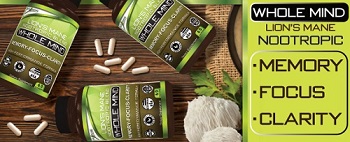
Our Formula includes: Lion’s Mane Mushrooms which Increase Brain Power through nerve growth, lessen anxiety, reduce depression, and improve concentration. Its an excellent adaptogen, promotes sleep and improves immunity. Shiitake Mushrooms which Fight cancer cells and infectious disease, boost the immune system, promotes brain function, and serves as a source of B vitamins. Maitake Mushrooms which regulate blood sugar levels of diabetics, reduce hypertension and boosts the immune system. Reishi Mushrooms which Fight inflammation, liver disease, fatigue, tumor growth and cancer. They Improve skin disorders and soothes digestive problems, stomach ulcers and leaky gut syndrome. Chaga Mushrooms which have anti-aging effects, boost immune function, improve stamina and athletic performance, even act as a natural aphrodisiac, fighting diabetes and improving liver function. Try Our Lion’s Mane WHOLE MIND Nootropic Blend 60 Capsules Today. Be 100% Satisfied or Receive a Full Money Back Guarantee. Order Yours Today by Following This Link.


| Visits: | 1,781,436,937 |
| Stories: | 8,592,192 |
Whistler Blowers, Insiders

